MARITZA GRANADOS-MANJARRÉS
Misha de papel
es

Nido, 2021/22 Folded paper, variable
Jaula para monstruos, 2018 Cutted and folded cardboard, variable

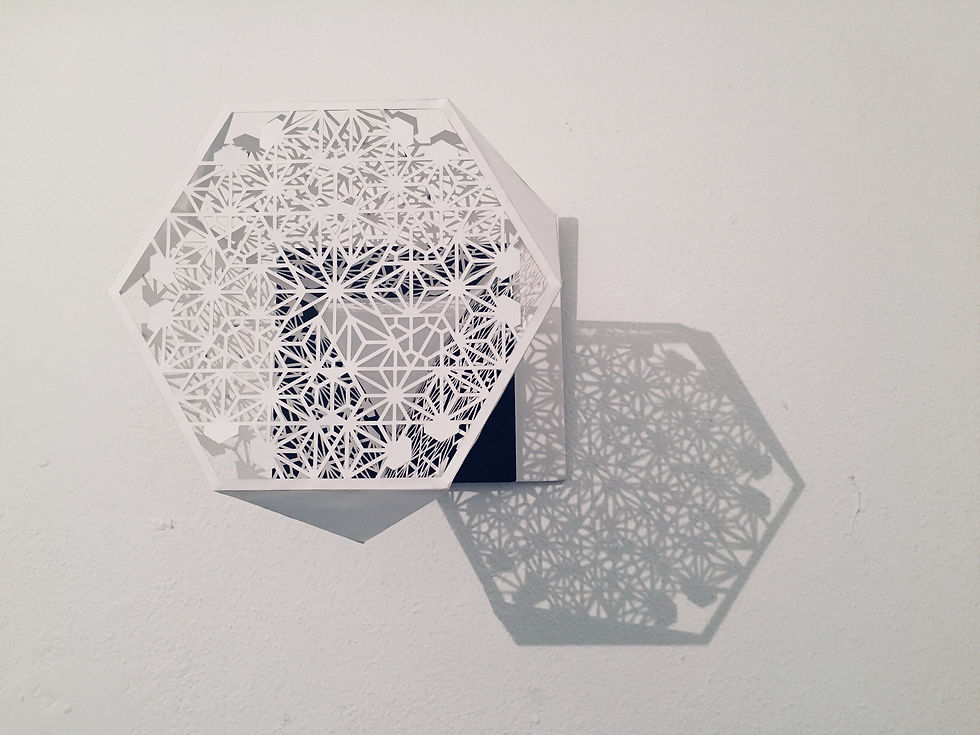
Flat origami, 2016 Folded paper, 30x30x10 cms
Nido, 2021/22 Folded paper, variable
Maritza Granados-Manjarrés, Ph.D. · Paper engineering · Bogotá, Colombia
About
Maritza Granados-Manjarrés, Ph.D. (1980), is an artist based in Bogotá, Colombia. Her academic profile is available here.
[Statement]
I work with paper and with project pedagogy, and I understand both as ways of enquiring into what it means to exist and to make. Creation is not the resolution of an exercise but an ontological act: the project and the creator are inseparable. I carry that conviction into my sculpture. My series begin in lived experience and in the questions that experience raises. In them, making is a form of autoethnography: a way of taking my own experience as a phenomenon worthy of study and situating it within a wider cultural condition.
Verbal frustration: Dear architecture, I hate you. Amsterdam, Holland
Internationale Papierkunst Triennale. Deggendorf, Germany
Feast on paper - Shanghai International Paper Art Biennial. Fengxian Museum, Shanghai, China
Fine Arts Pavilion (UCA). Buenos Aires, Argentina.
School of architecture (UNSAM). San Martín, Argentina.
eMMe - FADU, UBA. Buenos Aires, Argentina.
The First Shanghai International Paper Art Exhibition. Shanghai, China
On Paper - Supreme Exhibition. Shanghai, China.
Amateras Mini Paper Art Exhibition. Sofia, Bulgaria.
NAOPA finalist exhibitions. Parrsboro & Montreal, Canada.
II Encuentro Javeriano de Arte y Creatividad. Bogotá, Colombia.
Feast on Paper. Shanghai/Guangzhou, China.
NAOPA finalist exhibitions. Parrsboro & Montreal, Canada.
World Art Print Annual - Mini Print. Sofia, Bulgaria.
Amateras Mini Paper Art Exhibition. Sofia, Bulgaria.
Works
The exploration of the cages unfolds from two conceptual standpoints: on the one hand, the idea of freedom as illusion; on the other, a geometric and morphological preoccupation with the Platonic solids. The enquiry itself is situated in our own freedom: in the way contemporaneity sells us an idea of freedom that is a simulacrum and one for which, in any case, we would not be prepared. Conceptually, the series responds to enquiries into the notion of freedom in Hegel, for whom freedom is the essence of the human spirit. This essence led me to the dialectic of master and slave, in which two desiring consciousnesses confront one another, and one ends up subjected to the will of the other.
When we submit to the desire of the other and relinquish our own freedom, we also surrender ourselves to matter. From there we build, and in that act of building we negate the one who negated us, moving toward a higher form of existence. This is our cage: a construction that begins in subjection yet leads us to explore other forms of existence. It is a cage we appropriate to metabolize it, but which at the same time becomes the negation of having been negated. Formally, the ideal of freedom took shape through an exploration of the Platonic solids, geometrically decomposed and perforated, their complexity hollowed out, to give form to the prisons we choose every day. A paper creature inhabits their interior.


Jaula para zapallo, 2019
Cut and folded cardboard, 30 x 30 x 10 cms
Jaula para monstruos, 2018
Cut and folded cardboard, 30 x 30 x 10 cms
Jaula para tomates, 2017
Cut and folded cardboard, 30 x 30 x 10 cms


Jaula para un amigo, 2017
Cut and folded cardboard, 10 x 10 x 10 cms


Mientras la jaula sea linda, 2015
Cut cardboard, 10 x 10 x 10 cms
In 2011 I gave birth to my son, the child of an Argentine father and a Colombian mother. In 2015 I was awarded a scholarship for my doctoral studies and travelled with him to Argentina. For nearly ten years, my child was wrongfully retained by his father in Buenos Aires. In 2022 he briefly travelled to Colombia to see his grandmother for the last time.
I learned a great deal about justice: about how utopian, and how unjust, it can become.I began making the nests as an artistic, material search for pain. More than the long, piercing and deafening process I had to face, it was perpetual nesting that kept me sane through the decade he was not here: a way of restoring, myself, the void his absence left.


I keep falling, 2016
Folded paper and ink, 15,5 x 20 cms


Sin título, 2025 (commission)
Folded cardboard, 30 x 30 x 10 cms


Libélulas, 2017
Cut and folded paper, variable


Caterpillar, 2015
Cut and folded paper, 15 x 15 x 30


Nest, 2018
Folded paper, variable


Metaespacios, 2018 (ft. Cristhian Castro-Arenas)
Folded paper & tensegrities, variable


Sin título, 2016
Folded paper, variable


Filigrana #2, 2016 (comission)
Folded paper, 45 x 29 x 20


Filigrana #1, 2015
Cut and folded paper, 15 x 15 x 25
Origami plano · Flat origami
A surface that has been assigned a crease pattern allowing it to fold completely flat, without tearing or deforming, is considered “flat origami”. Mathematical analyses have proposed a series of conditions that a pattern must meet in order to fold flat, and extensive research has studied the properties it must have (J. Justin, T. Hull, M. Bern and B. Hayes). However, it is Robert Lang who has summarised them most accessibly across his work, and specifically in the lecture From Flapping Birds to Space Telescopes: The Modern Science of Origami, which he has delivered since 2005 at universities and conventions devoted to origami, mathematics and science. These conditions must be satisfied at each vertex of the crease pattern, i.e., at each point where two or more creases meet.




Crease pattern Fold until flat
A
Conditions

The crease pattern must be 2-colorable.
This means that it can only use two colors and two bordering regions can't have the same color.

The crease patterns must satisfy Kawasaki’s Theorem
The sum of the angle measurements of every other angle around a point, will be 180
α1+α2+α3...=β1+β2+β3...=180º
150º+30º=150º+30º=180º

The crease patterns must satisfy Maekawa’s Theorem
The difference between mountain folds and valley folds is always ±2
M − V = ±2.
3 − 1 = 2
Examples


